
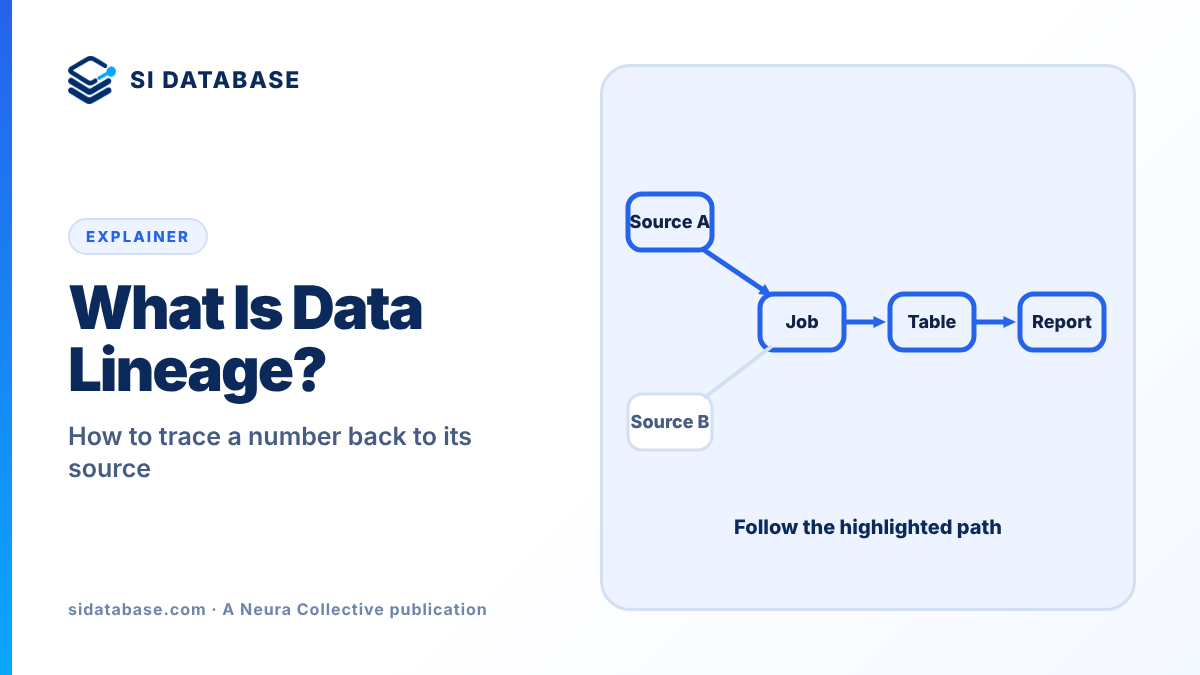
Data lineage is the record of where a piece of data came from and what happened to it on the way: which sources fed it, which jobs changed it, and which reports now depend on it. Picture a number on a chart with a trail behind it, and lineage is that trail.
Our own explorer offers a short, real trail. The International Telecommunication Union (ITU) compiles the indicator from national data and estimates. The World Bank distributes them as series IT.NET.USER.ZS in its World Development Indicators. The World Bank’s API serves them, and our Digital Divide Explorer retrieves them and draws the chart. Each hop can change something. In the response we retrieved on October 16, 2026, the API returns the 2024 value for the United States as 94.69380188; the explorer displays 94.7 because, as its footer states, values are rounded to one decimal place for display, while the downloadable CSV retains up to four decimals. Nothing is wrong with that step, but anyone tracing a number needs to know it happened.
How tools record lineage
In a company, the hops are jobs and tables, and tools record them as they run. The OpenLineage specification, an open standard for describing this activity, uses three core ideas.
- A job is a process that consumes or produces datasets, such as a workflow task, a query, or a model. Jobs are identified by “a unique name within a namespace.”
- A run is “an instance of a Job that represents one of its occurrences in time.” A job that runs every night produces a new run each night, and each run has its own identifier.
- A dataset is a discrete collection of data, such as a database table, a cloud storage object, or a directory.
As a run progresses, it emits state updates, usually starting with START and ending with COMPLETE, and each update can list the datasets the run read or wrote. Optional extras, which OpenLineage calls facets, add detail. The specification lists the source code location of a job, including a version such as a git commit; an error message for a failed run; the schema and data source of a dataset; and, for outputs, statistics such as row count and byte size.
Stitch those records together, and a map appears: the orders table feeds a nightly job, which writes a revenue table, which feeds a dashboard.
What lineage answers
- Why does this number differ from that one? Trace each upstream until the paths diverge.
- What breaks if we change this column? Trace downstream to find the reports and models that read it.
- Which run produced this table? The run record points to the job, its inputs, and, when facets are used, the code version.
Our article on data governance describes an upstream table that excluded refunds and affected downstream reports. Lineage is the tool that quickly finds those reports when downstream readers are recorded in its lineage map.
Lineage and provenance
Researchers and standards bodies use a related word, provenance. The W3C’s PROV-O recommendation, published on April 30, 2013, provides vocabulary for representing and exchanging provenance information. Its core classes are an entity, a thing such as a dataset or a document; an activity, “something that occurs over a period of time and acts upon or with entities”; and an agent, “something that bears some form of responsibility for an activity taking place.” Its relations include used, wasGeneratedBy, and wasDerivedFrom.
Lineage in data engineering and provenance in the W3C’s model describe much the same ground. In both, a thing came from other things through some process, and someone was responsible. Our explanation of knowledge graphs shows how provenance can travel with a claim, and it carries the same caution that applies here: provenance helps investigators examine a claim; it does not certify the claim as true.
What lineage cannot do
Lineage describes movement, not correctness. A trail can lead cleanly to a source that was wrong from the start. Our article on why clean data is not necessarily correct data makes the same point about tidy records: orderly handling does not prove accuracy.
Lineage can also be incomplete. Automated tools record only what runs through them, so a step in which a person pastes numbers into a spreadsheet may leave no mark. Tools also differ in how much detail they capture, and a record that shows tables may not show which columns fed which. (These limits are our observations about practice, not claims from the specifications.)
Starting with what you have
A team does not need a full lineage platform to begin. Pick the five reports that matter most. For each, write down where every number comes from, which jobs touch it, and who owns each step. That list, kept up to date, answers most of the questions above. Tools can automate it later.
The goal is simple: when someone asks where a number came from, the answer should take minutes and not depend on one person’s memory.
Sources and further reading
- World Bank Indicators API, IT.NET.USER.ZS, United States, Brazil, and India, 2013–2025: observations rechecked October 16, 2026; response source update October 8, 2026. Original data source: ITU; distributed by the World Bank under CC BY 4.0.
- OpenLineage, Object Model: jobs, runs, datasets, run events, and facets.
- W3C, PROV-O: The PROV Ontology: entities, activities, agents, and provenance relations.
- World Bank DataBank, series IT.NET.USER.ZS metadata: source and distributor of the series used in the example.
- International Telecommunication Union, Data collection and questionnaires: national reporting, verification, harmonization, and dissemination.
- World Bank Data Help Desk, API Basic Call Structures: how the API serves series.
Read next
Know someone who would find this useful?
Share it with a colleague or post it where your team talks about data.

The Data Behind AI
A 48-page illustrated guide to databases, search, and intelligent systems. No coding required.
Explore the book →