
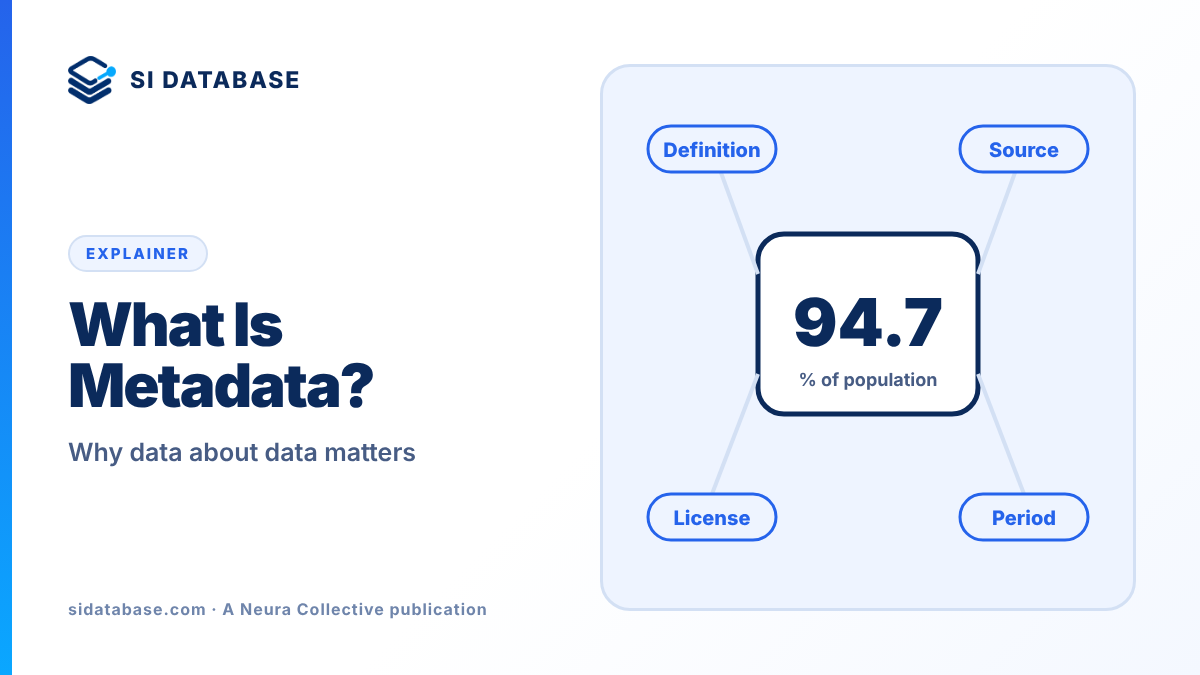
Metadata is information that describes other data: what it is, where it came from, how it is organized, and what you may do with it. A common shorthand, used in the National Information Standards Organization’s primer on the subject, is “data about data.”
A single number shows why that matters. Suppose a chart says 94.7. The number means nothing until you learn what it counts, who counted it, and when. The World Bank’s catalog entry for the series behind our Digital Divide Explorer supplies exactly that. The series is named “Individuals using the Internet (% of population),” with the code IT.NET.USER.ZS. Its definition reads: “Internet users are individuals who have used the Internet (from any location) in the last 3 months.” The source is the International Telecommunication Union (ITU). The license is CC BY 4.0, the series is annual, and the entry carries a note on limitations. With those facts, 94.7 becomes a statement: about 94.7 percent of people in the United States used the internet in 2024, as the ITU defines use. Without them, it is a number.
Three kinds of metadata
NISO’s 2017 primer describes several types of metadata. Three provide a practical starting point for asking what a dataset is missing.
- Descriptive metadata helps people find and identify a resource. Examples include a title, an abstract, an author, and keywords. For a dataset, this is the indicator name and its definition.
- Structural metadata shows how a compound object is put together. The primer’s example is the order of pages that form chapters. For a dataset, this is how tables, columns, and files relate to one another.
- Administrative metadata helps manage a resource over time. Examples include when and how it was created, its file type, and who can access it. It includes rights management and preservation information. For a dataset, this covers the license, the update schedule, and the owner.
The mapping from books to datasets is ours; these categories come from the 2017 primer, which also discusses markup languages.
Catalogs and shared vocabularies
A data catalog collects metadata about many datasets in one place, so people can search it. The World Wide Web Consortium (W3C) publishes a standard vocabulary for this job called DCAT, short for Data Catalog Vocabulary. Version 3 became a W3C Recommendation on August 22, 2024. Its abstract says that “DCAT is an RDF vocabulary designed to facilitate interoperability between data catalogs published on the Web.”
DCAT defines a small set of building blocks. A catalog is “a curated collection of metadata about resources.” A dataset is a conceptual entity that can have one or more distributions, and a distribution is an accessible form of the dataset, such as a downloadable file. Properties include a title and a publisher, defined as “the entity responsible for making the resource available.” Because catalogs that share a vocabulary describe datasets in the same terms, a search can cover several catalogs at once.
Our article on data governance describes the organizational side: a catalog records the meaning of each dataset, its owner, and the conditions for using it. A shared vocabulary makes that record readable by other systems as well as by people.
Why metadata matters for AI
An AI system that retrieves documents depends on metadata more than it might seem. As our article on exact-word search notes, retrieval systems can narrow results with filters for date, document type, and permissions. Each filter reads a metadata field. If the date field is incorrect, a search for the latest report may return last year’s report. If permissions metadata is missing and the system fails to enforce access elsewhere, a document may reach someone who should not see it.
Metadata also carries the trail from an answer back to its evidence. A knowledge graph, for example, can record where a claim came from and when it was valid, which turns metadata into something a query can use.
Metadata can be wrong
Metadata is a claim made by a person or a system, and it can be stale, missing, or inconsistent. The World Bank’s own entry for the internet series warns that “the quality of data varies among reporting countries,” and that some countries report on fiscal years ending in March or June while the ITU’s reporting year ends in December, which can cause timing mismatches. That warning belongs to the metadata too, and it changes how a careful reader treats a comparison.
Five fields to read before the numbers
When you meet a dataset you have not used before, read these first:
- Definition: what exactly is counted or measured.
- Source: who produced it, and who distributes it.
- Period and frequency: which years or dates it covers, and how often it updates.
- License and citation: what you may do with it, and how to credit it. The World Bank entry asks users to cite the ITU for third-party use.
- Limitations: the caveats the publisher lists.
Five minutes spent there often prevents a wrong conclusion that no chart could have corrected.
Sources and further reading
- World Bank Indicators API, IT.NET.USER.ZS, United States, Brazil, and India, 2013–2025: observations rechecked October 16, 2026; response source update October 8, 2026. Original data source: ITU; distributed by the World Bank under CC BY 4.0.
- World Bank DataBank, Individuals using the Internet (% of population), series IT.NET.USER.ZS: definition, source, license, periodicity, and limitations.
- NISO, Understanding Metadata: What Is Metadata, and What Is It For? (Jenn Riley, 2017): the definition and types of metadata; the page links to the complete primer.
- W3C, Data Catalog Vocabulary (DCAT), Version 3: catalogs, datasets, distributions, and properties.
Read next
Know someone who would find this useful?
Share it with a colleague or post it where your team talks about data.

The Data Behind AI
A 48-page illustrated guide to databases, search, and intelligent systems. No coding required.
Explore the book →